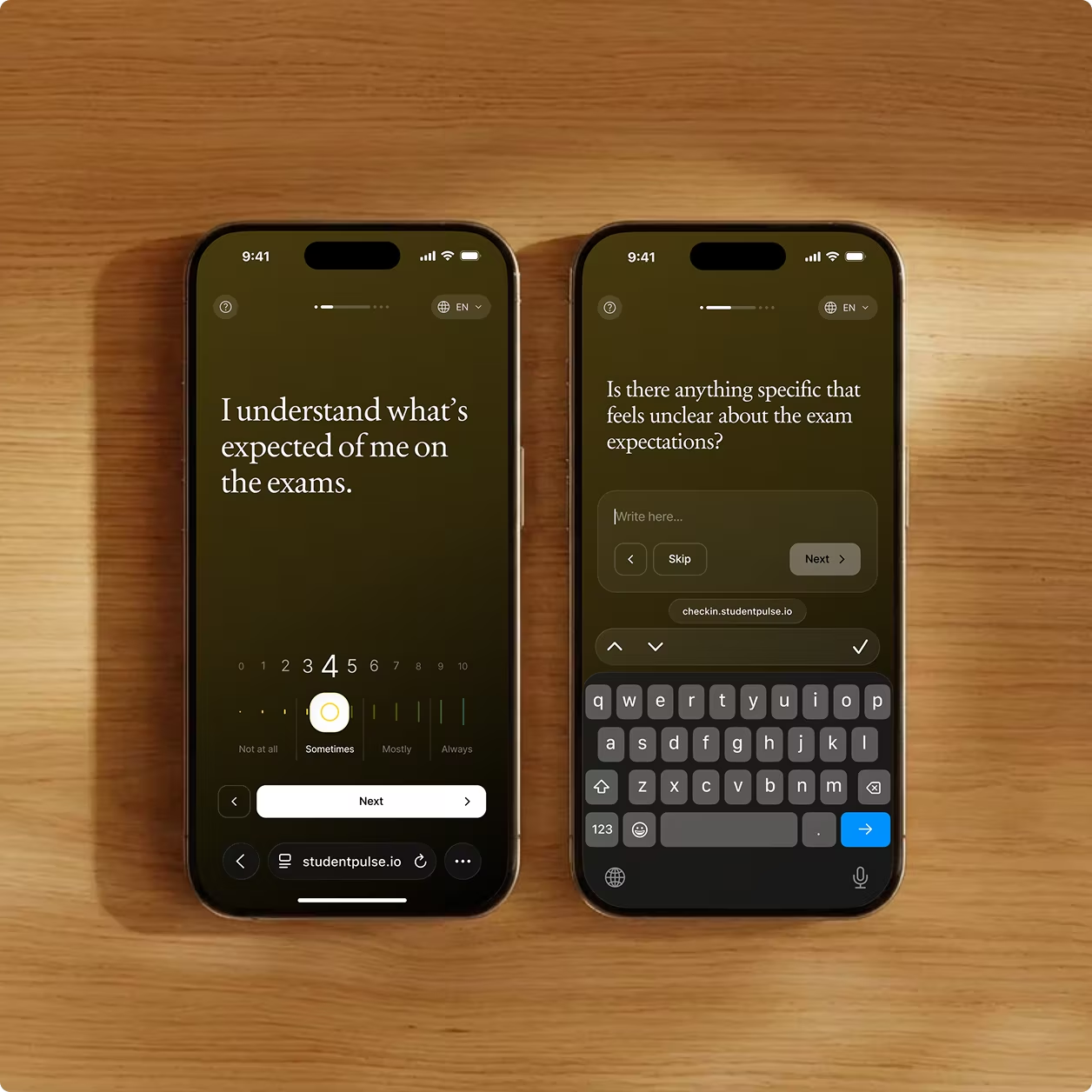
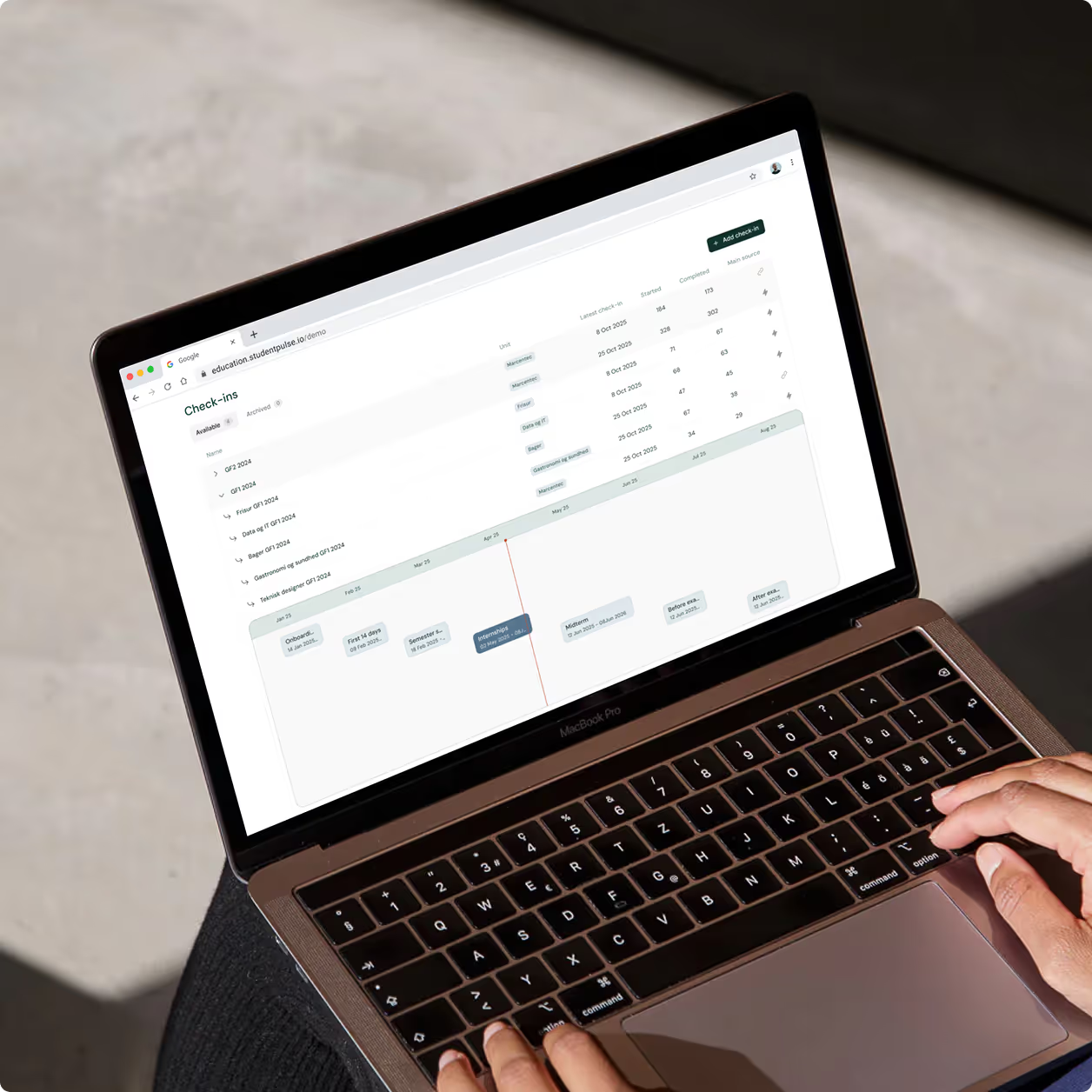
One loop, end to end: students answer a short check-in, AI reads every reply against a research-grounded framework, and the priorities land with the team that can act. Try the student side yourself.
Live simulator · slide a score, get matched, book a chat
How it works
Listen, understand, and act, as one loop
Real change runs on one loop. First you listen: honest feedback only comes when you ask students in the right place, at the right moment, with the right question, a little and often instead of once a year. Then you understand: thousands of answers turn into clear priorities only when a research-grounded framework reads every one and shows what actually matters. Then you act: those priorities reach the team that can move on them, students are guided to the right support, and every change is shown back to them. Listen, understand, act, and the loop begins again, a little stronger each term.
Select any capability below to see where it lives in the platform.
01
Listen
Survey fatigue and fragmentation→One connected feedback stream
Platform view:Micro check-ins
02
Understand
Feedback that arrives too late→Priorities the moment answers land
Platform view:AI insight layer
03
Act
A broken feedback loop→A loop students can feel
StudentPulse· Weekly digest1 of 6 · Monday, 08:00
TopicAct now
BSc Computer Science: confidence in achieving academic goals collapsed to 5.3
5.3Now
−3.1
8.4Last year
7.9Own baseline
142 replies
On “I'm confident that I can achieve my academic goals”, BSc Computer Science is at 5.3, down from 8.4 the same period last year, the single largest topic decline at the university. Open comments point to workload and unclear assessment. Recommended next step: a programme review with the department head.
BSc Computer Science
Explore
TopicAct now
“I'm confident that I can achieve my academic goals” is sliding across six programmes at once
5.3Computer Science
−3.1
7.2Law
−1.8
6.9Civil Eng.
−1.5
521 replies
The same topic is down year over year in Computer Science, Law, Civil Engineering, Nutrition, Economics and Psychology, and steeply so in the first three. When one question moves across six programmes at once, treat goal-setting support as an institution-level lever, not six separate fixes.
6 programmes
Explore
TopicFix
“I feel safe on campus” dropped to 7.0 on the west campus
7.0Now
−1.6
8.6Last year
8.7Institution
96 replies
On the west campus, “I feel safe on campus” is at 7.0, down from 8.6 a year ago and below the 8.7 institution average. Several comments mention lighting and evening access. This is a duty-of-care and reputational signal, not a satisfaction one, so it deserves a fast look on its own terms.
West campus
Explore
ActionsFix
213 of 214 surfaced actions are still untriaged, oldest 33 days
0%Completion
214Surfaced
33dOldest
Action queue
The platform has surfaced a full queue of concrete actions and all but one are still waiting to be triaged (the oldest from 7 May, one in progress, none done). The gap is not knowing what to do; nobody has started. This is an accountability gap to own at leadership level.
Action queue
Explore
TopicInvestigate
International students are struggling with financial stress, at 6.0
6.0Now
−1.6
7.6Institution
64 replies
International students score 6.0 on “I can manage the financial stress of tuition, living costs, and debt”, against a 7.6 institution average. The gap is consistent across faculties, so it tracks the student segment rather than any one programme. Worth investigating as a targeted support question.
International students
Explore
TopicPraise
Social Wellbeing is holding at 8.7 across the institution through the assessment period
8.7Now
+0.1
8.6Last year
8.7Institution
6,619 replies
Social Wellbeing sits at 8.7 institution-wide and has stayed steady through the assessment period, when it usually dips. Outside the flagged programmes the base is strong, which is the context for reading the risks above: they are concentrated, not systemic.
Institution-wide
Explore
Advisory by design: Observations flags, ranks and explains. You decide: act on it, email it to a colleague, snooze, or dismiss, with a trail of who resolved what. Illustrative example.
Platform view:Support, automatically
The data model
One data model underneath all of it
This is what makes everything run smooth underneath. A single source of truth, five years and three million answers in the making, that every question, every reply, and every action feeds, and that flows to the team who can act on it. Not a survey with AI bolted on. A shared structure, so the work compounds instead of starting over each term.
3 domains38 topics155 subtopicsHover to trace a path, click to open it in the framework
How students cope, stay motivated, and balance their lives.
Positive MindsetAcademic ConfidenceDiscipline and OrganizationAcademic Skills GrowthAcademic Independence
Study Strategy EffectivenessStudy Routines
Feedback Impact ConfidenceParticipation ConfidenceAcademic Goal ConfideceEveryday Life Skills ApplicationExam Confidence
Housing and AccomodationFinancial SupportCareer GuidanceAcademic SupportTutoringSupport NavigationCounseling and Wellbeing ServicesInternational Student Support
Belonging, relationships, and the climate students learn in.
Peer NetworkCampus Community BelongingSelf-Advocacy and ExpressionClass BelongingRespect and Inclusion
Cooperation over CompetitionPeer-to-Peer HelpStudy Groups
Progression vs. RedundancyCourse-Program AlignmentIntegration between TopicsPrerequisites FitModule Choice & Flexibility
Curriculum RelevanceContent Level & DifficultyAlignment with Learning Objectives
Course Expectations MatchCourse Recommendation
Bring your own questions
Custom institution questions are tagged to the same topics as everything else, so two schools can word a question differently and still feed one topic. That is what keeps every answer validated, clean, and comparable across programmes, terms, and the wider sector.
The model reads every answer and routes it, live
Live · every answer read the moment it arrives
4.6
Workload strain, colliding deadlines
Nursing, 2nd semester · 21 similar comments
Workload→ Quality
5.1
Group formation not working
IT, 1st semester · 9 comments
Group work→ Wellbeing
9.1
Mentoring pilot scoring high
Health sciences · programme-level signal
Peer support→ Leadership
6.2
Feedback on submissions too slow
Humanities, 3rd semester · 14 comments
Feedback on assignments→ Quality
AI reads the newest answer and routes it
Theme
Workload
Signal
Below average
Route to
Quality
Routed this week
Wellbeing team
triage + outreach
12
Quality team
programme signals
23
Leadership
completion outlook
8
Simulated loop, real working method.
Routed to the team that can act
Swipe for more
For wellbeing
Personal and social signals: who is struggling and whether they are reaching support.
PersonalSocial
For leadership
The institution-level rollup: completion risk and where to put resources, on the same numbers.
All three domains
For quality assurance
Academic and teaching signals, mapped course by course for the review.
One student comment enters the model once. Each team receives it in their own language, with a recommendation they can act on. Pick a signal to see how it lands.
4
One data point · Academic · Workload
“Three big deadlines landed in the same week again, I could not give any of them my best.”
For Wellbeing
Reads it as
Rising stress and burnout risk in the cohort.
Recommended action
Flag the cohort and share stress and time-management self-help before the deadline cluster.
Based on 21 comments · illustrative
For Quality assurance
Reads it as
An assessment scheduling problem, not student effort.
Recommended action
Spread the semester’s assessment deadlines and coordinate them across course components.
Based on 21 comments · illustrative
For Leadership
Reads it as
A completion risk if it repeats every term.
Recommended action
Add deadline distribution to the programme review and track it against completion.
No parallel universe to maintain. Rosters in from your SIS, check-ins out through your LMS, results into your BI stack.
Swipe for more
LMS delivery
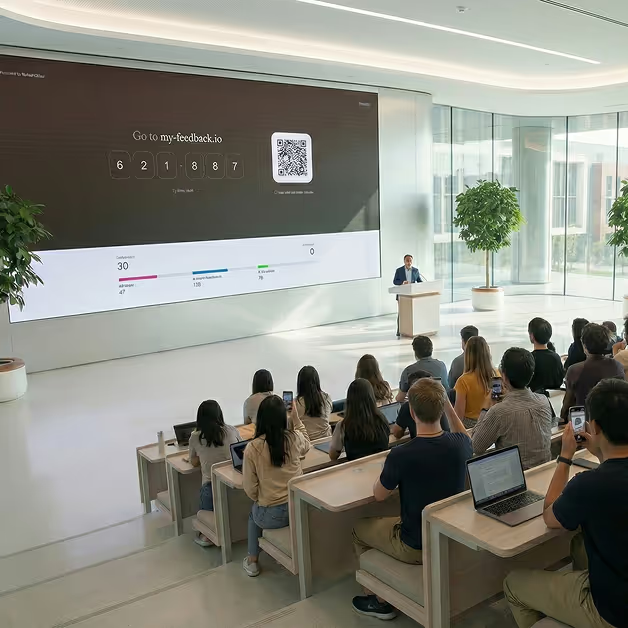
Check-ins reach students inside the learning environment they already use, or by plain link and QR code, no login needed.
SIS rosters
Cohorts, programmes, and enrolment sync from your student information system. No manual lists to keep alive.
Single sign-on
Staff log in with your existing identity provider. Access follows your directory, not another password.
Power BI
Results stream live into the dashboards leadership already looks at, on the shared framework.
CSV & export API
Your data, never locked in. Clean exports for any analysis pipeline you run today or later.
Anonymity travels with the data
Minimum group sizes are enforced in every integration and export, honest answers stay safe everywhere the data goes.
Which LMS, SIS, and IdP integrations are live for your setup is confirmed in the demo.
Insights across the sector
Your numbers mean more next to everyone else's
Because every check-in maps to the same data model, your results benchmark against an anonymized, aggregate sector dataset of 3M+ answers. No institution or student is ever identified.
Every check-in maps to one shared framework, so your institution benchmarks against comparable ones across the platform, and you see what is already working elsewhere, straight from students. The anonymized dataset makes each institution’s own numbers mean more.
And you are not on your own with it. Your StudentPulse partner helps you read the benchmark, set priorities with your teams, and translate the picture for the board, while the sector view shows which moves actually shifted outcomes elsewhere. Software, plus the people and research behind it.
Aggregate and anonymized. No institution or student is ever identified, and no student IDs are stored.
"The ability to get real-time feedback from students has been transformative. We can now adjust courses in real time, improving student satisfaction and engagement."
Carlos Augusto Santos SilvaVice President of the Pedagogic Council, Instituto Superior Técnico (IST)
85%participation, up from 60%
Real timecourse adjustments mid-semester
11,296students, largest engineering school in Portugal
Most institutions are live within a term. Your StudentPulse partner handles configuration, the first check-in journeys, and staff training; your team agrees the goals and which programmes to start with. There is no large project group to stand up.
Rosters sync in from your SIS, check-ins go out through your LMS (or by plain link and QR code, no login), staff sign in with your existing identity provider, and results stream into Power BI or export by clean CSV and API. Exactly which integrations are live for your setup is confirmed in the demo.
Yes. Your data is never locked in. Clean CSV exports and an export API mean any analysis pipeline you run today or later keeps working, and minimum group sizes travel with the data through every integration and export.
Only if you choose to. StudentPulse can run fully anonymous, or you can connect student identities so support and follow-up can be personal. Identifying students is optional and configured per institution, with minimum group sizes on every aggregate view and role-based access throughout.
A survey tool collects answers and leaves the reading to you. StudentPulse closes the loop: every reply is read against one research-grounded framework as it arrives, the priorities are routed to the team that can act, and the actions taken are documented back to students.
The platform does the reading. Observations surfaces the few things that need a decision each day, ranked and routed, so staff act on a short list instead of digging through comments. Role-specific views mean each team sees only what is relevant to them.
Every reply is classified against the same research-grounded framework, and every recommendation is backed by the actual student comments behind it, so you can read the evidence, not just the summary. Staff stay in the loop: the platform prioritises and suggests, people decide and act.
Student data is hosted in the EU and the platform is built GDPR-first, with a standard DPA and a subprocessor list your DPO can review up front, plus role-based access throughout. The Trust centre carries the full security position, including anonymity thresholds and how identity is governed.
Completion averages 88%, well above the 20 to 30 percent typical of course surveys, because check-ins are short and feel like a conversation. Higher response rates make the picture more representative, and you can see completion by cohort, so you know where it is strong and where to nudge.
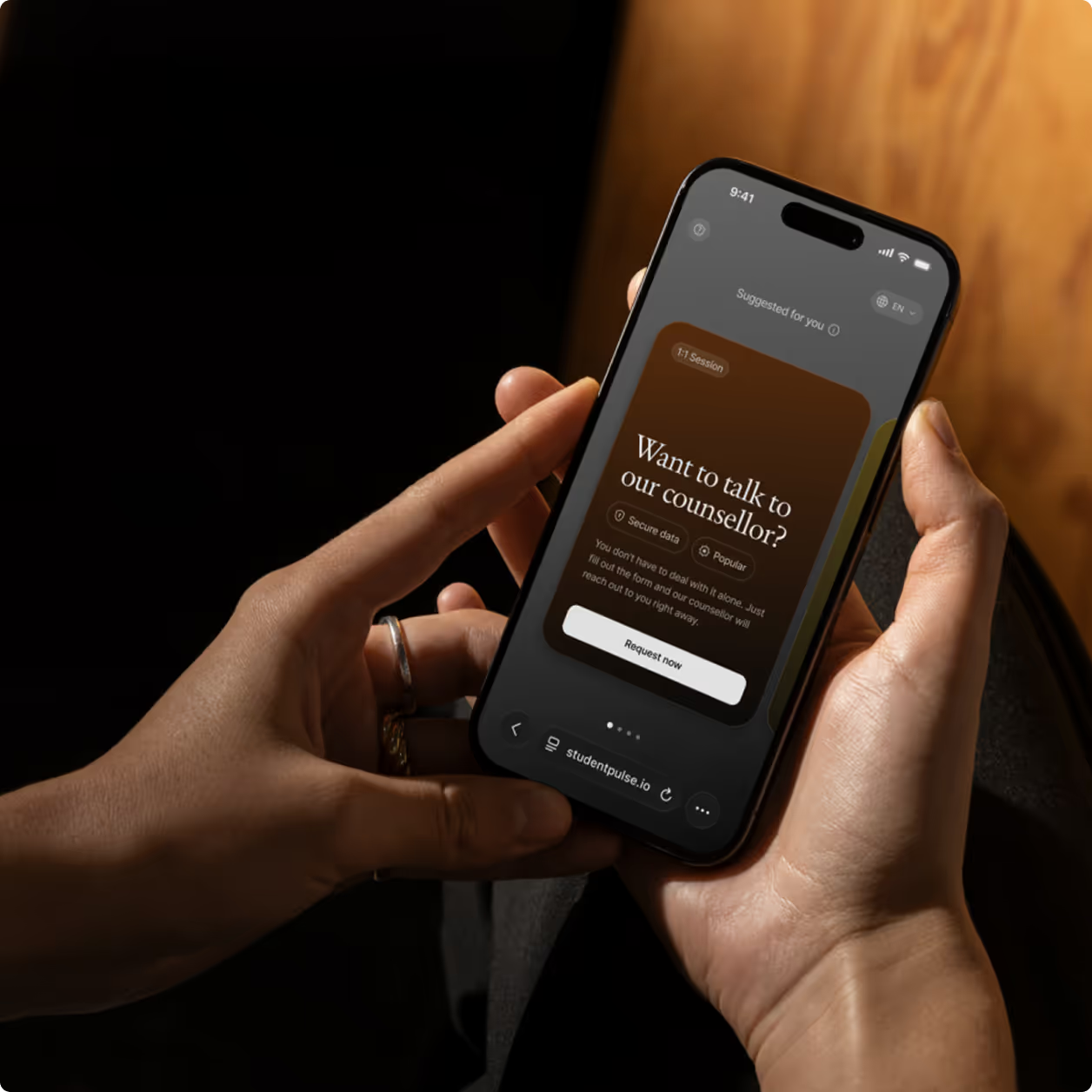
The moment an answer signals a potential crisis, the student is shown help resources and a direct route to the right service, out of hours included. Depending on how you have configured StudentPulse the signal can stay anonymous or be tied to the student, so your team follows up the way your safeguarding policy allows. Detection is the platform; the duty of care stays with your institution.
See the loop with your own check-in
In the demo we configure a real check-in for one of your programmes.